Behavioral and Experimental Economics Discussion Group
(行為與實驗經濟學討論會)
Books for Background Reading:
1.
Neuroeconomics (2008), edited by Paul Glimcher,
Colin Camerer, Ernst Fehr and
Russell Poldrack, three of which have visited Taiwan during
our colloquium series. (NTU library has
online book
chapters just like online journal articles.)
2.
Handbook of Experimental Results (2008), edited by Charles Plott and Vernon
Smith. (NTU library has
online book
chapters just like online journal articles.)
3.
Behavioral Game Theory (2003), by Colin Camerer.
(Princeton UP has
chapter 1 online.) See also Colin's
Pinkel
lecture on this.
4.
Handbook of Experimental Economics, Vol.1 (1995) and Vol.2 (forthcoming),
edited by John Kagel and Alvin Roth. (Summary of Vol. 1 and Chapters of
Vol.2 are on
Al
Roth's website.)
2016/10/18-19:
Sarah F. Brosnan
(Georgia State Univ)
The Evolution of
(un)Fairness
((不)公平偏好的演化):
10/18
(二)
2-4pm
at Yang-Ming University (陽明大學活動中心第一會議室)
ABSTRACT:
The human sense of
fairness is an evolutionary
puzzle; why do we put so much
value on what we receive
relative to others? One answer
to this question emerges from
studying other species. Although
fairness itself is empirically
intractable, it can be
translated empirically into
responses to reward
distribution, and studying other
species’ reactions can tell us
something about the evolution of
our own behavior. Indeed, humans
are not alone in disliking
inequity in reward
distributions; many species
protest receiving less than a
partner for the same task, and
this tendency occurs primarily
in species that cooperate
outside kinship and mating
bonds, indicating a link between
the two behaviors. However, a
full sense of fairness requires
not only this, but also that
individuals notice and seek to
equalize outcomes to their own
detriment. There is less
evidence of this latter reaction
nonhuman species, although it
has been documented in our
closest relatives, the apes.
This reaction probably reflects
an attempt to forestall partner
dissatisfaction with obtained
outcomes and its negative impact
on future cooperation.
Therefore, it is likely that the
evolution of this response,
combined with advanced abilities
at inhibition and planning,
allowed the development of a
complete sense of fairness in
humans, which functions not to
provide equality for its own
sake, but for the sake of
continued success in
cooperation.
The Evolution of
Coordination
(協調行為的演化):
10/19 (四)
2:30-4pm
at NTU Psychology (心理系北館視聽教室N100)
ABSTRACT:
Humans routinely confront
situations that require
coordination between
individuals, from mundane
activities such as planning
where to go for dinner to
incredibly complicated
activities, such as
international agreements. How
did this ability arise, and what
prevents success in those
situations in which it breaks
down? To understand how this
capability has evolved, my lab
uses the methodology of
experimental economics to
address these questions in a
cross-species fashion.
Experimental economics is an
ideal mechanism for this
approach, as it is a
well-developed methodology for
distilling complex
decision-making in to a series
of simple decision choices,
allowing these decisions to be
compared across species and
contexts. We have used this
approach to investigate
coordination and
anti-coordination in New World
monkeys, Old World monkeys, and
great apes, including humans,
using identical methodologies.
We find that there are
remarkable continuities of
outcome across the primates,
including humans; all species
are able to coordinate and, to
our surprise, in at least some
circumstances, all species were
able to find the Nash
Equilibrium in an
anti-coordination game. On the
other hand, there are also
differences in outcomes across
the primates, and studies using
simulated opponents indicate
that even when the same outcome
is reached, there are important
differences in the mechanisms
each species uses to reach these
outcomes. I consider both the
similarities and differences and
what these can tell us about the
evolution of coordination across
the primates.
2014/7/2-4 Symposium on Neuroscience and Behavioral Economics
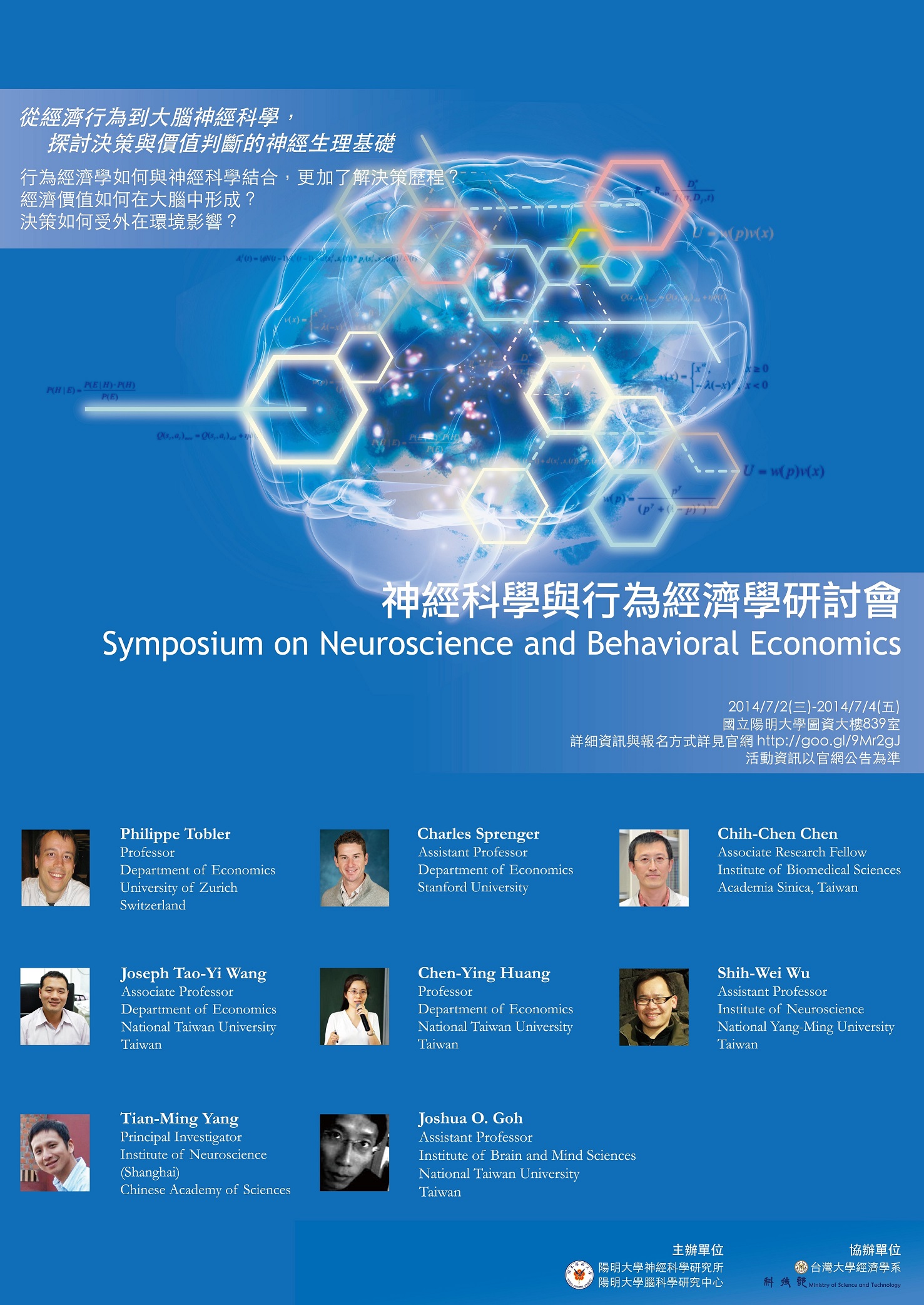
The conference schedule is
here. Below is the invitation message in Chinese:
神經經濟學是企圖結合神經科學、經濟學、和心理學等領域,了解人類決策的跨領域學門。自1990年代末期開始,經過十多年的發展,已在神經科學領域占有一席之地。發展過程中,我們看見了經濟學和心理學的理論、實驗及研究方法,對決策相關神經科學研究的重大影響。然而,以神經科學為基礎的決策研究,是否也會對經濟學產生根本的改變,依然是個大問號。
其中一個重要的關鍵在於跨領域交流的不足。台灣神經經濟學學術研究群的成立,便是想要在此挑戰中有所突破。成立之初,僅有三到四位成員,其中有神經科學家和經濟學家。自2011年起,我們開始籌辦神經經濟學系列演講。為強化跨領域交流,此系列演講的每一位講者,所進行之公開演講,有一場會在經濟學系或心理系舉行,另一場則在神經科學相關系所。舉辦至今,已邀請11位國際知名學者,舉辦超過22場公開神經經濟學系列演講。逐漸,台灣已有一個逐漸成型的研究交流平台,針對神經經濟學,讓不同領域專長的研究者,進行跨領域的對話與合作。
今年,在科技部人文社會科學中心的經費支持下,我們舉辦「神經科學與行為經濟學」學術研討會,為期三天。研討會邀請國內外神經科學、行為或實驗經濟學等領域之專家,分享當下神經科學與經濟學跨領域整合之成果與未來發展趨勢。
探討議題包含:
1. 經濟理論與大腦:經濟理論的組成元素 (如獎賞大小、機率、風險等)在神經生理上的證據
2. 違背理性選擇的大腦:情境式價值評估 (context-dependent valuation) 和誘餌效應 (decoy effect) 的神經計算機制
3. 價值評估 (valuation) 的神經系統:不同種類下之經濟選擇的運算機制
4. 決策成形 (decision formation) 的動態歷程:序列假設檢驗 (sequential hypothesis
testing) 的神經計算機制
5. 決策與老化 (decision making and aging):決策在老年族群的個別差異
6. 金錢買得到的正義:人們願意犧牲多少金錢來換取窮人「立足點」的平等 (例如:教育機會)?重新解讀羅斯「正義論」的「差異原則(difference
principle; maximin rule)」
7. 跨期選擇 (intertemporal choice) 下的當下偏誤 (present
bias):奬賞來源如何影響跨期選擇之動態不一致性 (dynamic inconsistency) 在此誠摯邀請您一同參與這場跨領域的交流!
2013/12/16-20:
Ian Krajbich
(Ohio State Univ)
A Common
Mechanism
Underlying
Value-based
Decision
Making
(各種用價值來做的決策背後的共通機制):
12/19
(四)
10:10-11:30am
at Yang-Ming University (陽明大學活動中心第三會議室)
ABSTRACT:
People make numerous
decisions every day including
perceptual decisions like
walking through a crowd,
decisions over primary rewards
like what to eat, and social
decisions that require balancing
own and others’ benefits. The
unifying principles behind
choices in various domains are,
however, still not well
understood. Mathematical models
that describe choice behavior in
specific contexts have provided
important insights into the
computations that may underlie
decision making in the brain.
However, a critical and largely
unanswered question is whether
these models generalize from one
choice context to another. Here
I show that a model adapted from
the perceptual decision-making
domain and estimated on choices
over food rewards accurately
predicts choices and reaction
times in three independent sets
of subjects making social
decisions. The robustness of the
model across domains provides
strong evidence for a common
decision-making process in
perceptual, primary reward, and
social decision making. I also
provide evidence that visual
attention is a critical variable
in this process.
Benefits of
Neuroeconomic
Modeling:
New Policy
Interventions
and Predictors
of Preference
(神經經濟理論的價值:政策建議與偏好預測):
12/19 (四)
1:45-3:15pm
at NTU Economics (社科院第2教室)
ABSTRACT:
From its
inception, neuroeconomics has
promised to use knowledge from
neuroscience and psychology to
improve models of economic
decision making. Here we deliver
on this promise by introducing a
biologically-plausible
(drift-diffusion) model of
decision making that is able to
predict behavior, with fixed
parameters, in random groups of
individuals across very
different tasks. The model also
goes beyond the traditional
economic approach because it is
able to predict not only choices
but reaction times as well. But
why should economists care about
modeling reaction times? For
one, as predicted by the model,
we consistently observe that
people spend too much time on
irrelevant choices for which
they are nearly indifferent. In
a world of time constraints,
time spent on unimportant
decisions represents an
opportunity cost, namely time
not spent on more important
decisions. To help subjects
overcome this inefficient
allocation of time, we designed
an intervention that puts a time
limit on subjects’ choices. This
simple intervention
substantially improved subjects’
welfare in a time-constrained
choice experiment. Second, the
precise relationship between
reaction times and choice
probabilities implies that
reaction times can be used to
predict indifference points and
the strength of preferences. We
demonstrate this ability using
data from an Ultimatum Game
experiment. Overall, we show
that better understanding the
process by which people make
decisions can explain the basis
for stochastic choice behavior
and help us do both normative
and positive economics.
Value, Choices and the Brain: Toward a Neurobiology of
Decision-Making
(價值、選擇與大腦:建構決策的神經生理學):
2/20 (三)
2:30-4pm
at NTU Psychology (心理系北館視聽教室-N100)
Value, Choices and the Brain: Toward a Neurobiology of
Decision-Making
(價值、選擇與大腦:建構決策的神經生理學):
2/21 (四)
3:30-5pm
at Yang-Ming University (陽明大學活動中心第三會議室)
ABSTRACT:
Decision-making is a
critical cognitive capacity that
links perception to action.
Sensory physiologists emphasize
the effects of sensory inputs on
our decisions, but psychologists
and economists have long known
that decisions are also strongly
influenced by prior experience
concerning the “value” of
alternative choices, expressed
in terms of likely positive or
aversive consequences. Thus,
brain circuitry that mediates
decision-making should reflect
both sensory and value
influences. We have recently
been able to demonstrate both
effects in neurophysiological
recordings from the frontal and
parietal lobes of awake,
behaving animals. I will review
these empirical data and
consider their implications for
understanding how the brain
makes decisions.
Rethinking Gating: Selective Integration of Sensory Signals
Through Network Dynamics
(再思守門者:透過網路動態選擇性加入感知訊號):
2/22 (五)
2-3:30pm
at Yang-Ming University (陽明大學圖資大樓839教室)
ABSTRACT:
A hallmark of
decision-making in primates
is contextual sensitivity: a
given stimulus can lead to
different decisions
depending on the context in
which it is presented. This
kind of flexible
decision-making depends
critically upon gating and
integration of
context-appropriate
information sources within
the brain. We have analyzed
neural mechanisms underlying
gating and integration in
animals trained to perform a
context-sensitive decision
task. Surprisingly, both
relevant and irrelevant
sensory signals are present
within frontal lobe circuits
that form decisions,
implying that gating occurs
very late in the process.
Dynamical systems analysis
of the neural data, combined
with a dynamical recurrent
network model, suggests a
novel mechanism in which
gating and integration are
combined in a single
dynamical process.
Estimating and discounting the light field: perception of
surface color in three-dimensional virtual scenes
(估計與折算光場:人類如何感知3D虛擬實境的表面色彩):
9/19 (三)
2:20-4pm
at NTU Psychology (心理系北館視聽教室-N100)
ABSTRACT:
In everyday scenes, the
intensity and chromaticity of
the light absorbed by a matte
surface depends on its location
and orientation. I will first
describe recent experiments
intended to investigate surface
color and lightness perception
in 3D rendered scenes. We found
that the visual system partially
compensates for changes in
illumination due to changes in
location and orientation of test
surfaces. We show that, in
carrying out these experimental
tasks, observers effectively
represent the spatial
distribution, chromaticities and
relative intensities of light
sources in the scene. I’ll
describe additional experiments
where we assess how the visual
system estimates the
distribution of light in scenes
(the light field) and how it
used this information in
estimating surface colors.
Imperfectly optimal animals: Bayesian decision theory and the planning of
action
(人是最佳化不完全的動物:貝氏決策理論與計畫行動):
9/20 (四)
3:30-5pm
at Yang-Ming University (陽明大學活動中心第一會議室)
ABSTRACT:
The movement we plan is
not always the movement we
execute. Any discrepancy is the
consequence of own intrinsic
motor uncertainty. I will first
describe a model of movement
planning based on Bayesian
decision theory that takes our
own visual and motor uncertainty
into account in selecting
movement strategies and present
experimental evidence suggesting
that human movement planners
deviate slightly but
systematically from optimal in
many tasks (Schüür et al, under
review; Wu et al, 2009, 2011;
Zhang et al, under review; Zhang
& Maloney, 2012). While human
performance is impressive in all
of the tasks considered, it is
not optimal, and deviations from
optimality are potentially a
valuable source of information
concerning how humans represent
and make use of information
about uncertainty (Zhang &
Maloney, 2012).
Anticipatory Affect and the Neural
Prediction of Choice
(用預期心理的神經機制來預測人的選擇):
7/12 (四)
2:00-3:30pm
at Yang-Ming University (陽明大學圖資大樓839室)
ABSTRACT:
Affect occurs not only in
response to choice outcomes, but
also can precede and influence
choice. The spatial and temporal
resolution of functional
magnetic resonance imaging
(FMRI) now allows investigators
to visualize changes in neural
activity seconds prior to
choice. I will review efforts in
our laboratory to use FMRI to
visualize neural correlates of
"anticipatory affect," and then
to use that activity to predict
upcoming choice in domains
ranging from investing to
shopping. While current findings
suggest that neural activity
related to anticipatory affect
can be used to predict choice,
future optimizations of design
and analyses promise to improve
these predictions.
Related Readings:
1. Knutson, B., Greer, S. M. (2008).
Anticipatory affect: Neural correlates and consequences for choice. Philosophical
Transactions of the Royal Society B, 363, 3771-3786.
2. Knutson, B., Rick, S., Wimmer, G. E., Prelec, D., Loewenstein, G. (2007).
Neural
predictors of purchases. Neuron, 53, 147-157.
(I)
Sustaining Delay of Gratification: Potential
Cognitive and Neural Mechanisms
(如何延遲滿足?可能的認知與神經機制): 6/14 (四)
1:30-3:30pm
at NTU Economics (社科院第28教室)
ABSTRACT:
Persistence in the pursuit of
long-run outcomes is an
important dimension of
self-control. Decision-makers
often fail to persist: they
initially choose a larger, later
outcome, wait a period of time,
and then abandon this initial
choice in favor of a smaller,
immediate reward that had always
been available. Explanations for
this kind of dynamic reversal
usually assume that the timing
of outcomes is known with
certainty, but this is rarely
the case in the real world. When
outcome timing is uncertain, a
rational decision-maker should
continually update their
estimate of the remaining delay.
The value of continued
persistence therefore hinges
critically on the
decision-maker's prior
expectations regarding the
temporal uncertainty. We first
show that, with respect to
several self-control dilemmas,
decision-makers hold temporal
expectations that would
rationalize persistence failure
at some point. In a series of
behavioral experiments, we then
demonstrate that people adapt
their degree of persistence
depending on the statistics of
the environment, waiting longer
for delayed rewards when
persistence is profitable, and
exhibiting a reduced willingness
to wait when reversals are
merited. Finally, we show that
when individuals wait for
delayed rewards, BOLD activity
in medial prefrontal regions
reflects a continually updated
estimate of the delayed reward's
value. This activity varies
depending on the timing
statistics of the environment,
and predicts whether an
individual will abandon the
delayed outcome or continue to
persist. These results
demonstrate the critical role of
temporal expectations in
persistence, and suggest that
shaping these expectations could
encourage persistence when this
is desired.
(II)
When you keep changing your mind:
Psychological and neural mechanisms of preference reversals
(當你一直改變主意:偏好逆轉的心裡與神經機制):
6/17 (日) 2:45-3:45pm
at Yang-Ming University (陽明大學活動中心第三會議室)
ABSTRACT:
Systematic
inconsistencies
in people's
decisions
provide a
central
challenge to
rational choice
theories. A
classic example
is the
"preference
reversal
phenomenon": for
two gambles
matched in
expected value,
people
systematically
choose the
higher-probability
option but
provide a higher
bid for the
option that
offers the
greater amount
to win. Here we
use eye-tracking
and functional
brain imaging to
help better
understand the
mechanism
underlying such
reversals. We
find that the
preference
reversal
phenomenon is
accompanied by a
shift in visual
attention to
different
attributes, with
people fixating
probabilities
more during
choices and
payoffs more
during bids. We
also find a
corresponding
change in the
influence that
different
attributes have
on neural
signals linked
to the
computation and
comparison of
subjective
values. These
findings support
a "contingent
weighting"
explanation of
preference
reversals, which
locates the
source of the
reversal in a
task-dependent
change in the
weight given
different
attributes in
the valuation
process.
(I)
Imperfect Perception: An Integrated Approach
to Theory and Measurement (Andrew Caplin)
(不完全知覺:整合理論與測量的蹊徑):
3/13 (二) 3:30-5:30pm at Yang-Ming
University (陽明大學活動中心第一會議室)
ABSTRACT:
Psychologists and economists
share an interest in how
perceptual constraints impact
choice behavior. The talk
outlines a new approach to this
subject in which theory and
experiment are tightly
integrated. The results to date
provide a proof in principle
that this new approach produces
valid insights into the link
between attentional effort and
decision making mistakes. The
potential for richer measurement
to enhance our understanding of
this linkage is stressed.
(II)
The Human Brain Behind Financial Skill (Peter
Bossaerts)
(理財的大腦):
3/14 (三) 2:30-4:00pm
at NTU Psychology (心理系北館視聽教室)
ABSTRACT:
The talk
explores the
neurobiological
foundations of
human decision
making under
uncertainty.
What is the role
of emotions? How
does the brain
value uncertain
prospects? How
exactly do
important
neuromodulators
such as dopamine
and
norepinephrine
influence
assessment of
risky outcomes?
Are social risks
encoded
differentially,
or even
separately? What
algorithms does
the brain use to
learn risks
through
experience? Is
problem
complexity the
right way to
define the
limits of human
rationality?
(III)
Dialogues on Doing Research on Neuroeconomics: Values and
Challenges (Both)
(神經經濟學研究經驗談:展望與挑戰):
3/15 (四) 1:30-3:30pm
at NTU Economics (社科院第28教室)
DESCRIPTION:
In this roundtable discussion,
Dr. Caplin and Dr. Bossaerts
will share with us their
experience in doing research on
neuroeconomics and in
collaborating with
neuroscientists. In particular,
they will discuss, from the
perspective of someone whose
original training was in
economics or finance, the value
of meeting neuroscience and
psychology and the challenges
neuroeconomics as an
interdisciplinary field faces.
Researchers and students from
all areas of research are
welcome to attend. We especially
encourage students with
economics background to join us
on this roundtable discussion.
(I) Foundations of Economic
Analysis and the Neural Representation of Utility
(經濟分析之基礎與效用的神經表現):
12/15 (四) 1:30-3:30pm
at NTU (社科院經大講堂)
ABSTRACT:
Over the past decade there has
been a significant debate about
how economics and neuroscience
will influence each other. In
this presentation I will argue
that a meaningful synthesis of
these disciplines will emerge
only when serious economic
theory is used to guide
neurobiological inquiry. If this
occurs I argue that it will
yield a new class of economic
theories that make both economic
and neurobiological predictions,
both of which can be
meaningfully tested. To that end
I will describe an axiomatic
analysis of the neural
representation of utility
shocks. Based on fMRI data I
will argue for the existence of
a utility-like representation in
a specific brain area. I will
then show that a set of neural
measurements in this brain area
can predict later choice data.
Differences between economic
utility and the cardinal object
we refer to as "subjective
value", and the implications of
these findings for cardinal
theories of utility will be
discussed.
(II) The Neurobiology of Choice and the Evolving Standard
Model
(決策的神經生理學與「變動標準」模型):
12/16(五)
1:30-3:30pm
at Yang-Ming
University (陽明大學活動中心第三會議室)
ABSTRACT:
There is
now broad agreement in the neurobiological community about the basic features of
the neurobiological mechanism for human and animal decision making. I will
review this emerging standard model and then present two specific studies. They
will show how economic theory can inform neurobiological studies of brain
mechanisms in a highly valuable way - modifying existing neurobiological theory.
The second will show the reverse: neurobiological data that makes fundamentally
novel predictions about inconsistent human choice behavior.
(I)
Cognitive Neuroscience and Game Theory
(認知神經科學與賽局理論):
10/18 (二) 3:30-5:30pm at Yang-Ming
University (陽明大學活動中心第三會議室)
ABSTRACT:
Game theory provides a
vocabulary of canonical
strategic interactions that are
important in human social,
political, and economic life.
However, game theory has not
been applied in cognitive
neuroscience very much. This
talk will discuss some recent
studies using fMRI and disorders
(autism) to illustrate how game
theory might be useful in
cognitive neuroscience.
(II) When Game Theory Predicts Well and Badly: Evidence
from Lab, Field, and Chimps
(賽局理論的預測力:從實驗室內、田野現場與黑猩猩所得到的證據):
10/20(四) 1:30-3:30pm at NTU (社科院經大講堂)
ABSTRACT:
There is mixed
evidence of how
accurate game
theoretic
predictions are
compared to
human behavior.
Cognitive
hierarchy models
can reconcile
this evidence
systematically,
since they
sometimes
predict large
deviations and
sometimes
predict small
deviations. This
will be
illustrated with
lab behavior,
eyetracking, and
field data from
a Swedish
lottery. An
unusual domain
in which game
theory may work
surprisingly
well is when a
particular
species has
evolved a
special
niche-dependent
adaptation for
certain types of
fitness-enhancing
games. This is
addressed by
comparing humans
and chimps.
(I)
Bridging Risky Decision Making and Decision Under Risk
(「有風險的決策」與「風險下的決策」):
5/19 (四)
1:30-3:30pm
at NTU (社科院經大講堂)
ABSTRACT:
Neuroeconomics has provided
substantial insights into the
processes underlying economic
concept of "decision under
risk." However, this work has
largely failed to provide
insights into "risky decision
making", a lay concept with
significant public health
implications. I will discuss
the relation between these
concepts, and outline how
dynamic decision making tasks
provide the potential to bridge
the gap between these two
concepts.
(II) Towards a Semantic Infrastructure for Cognitive
Neuroscience: The Cognitive Atlas Project
(認知神經科學圖譜):
5/24 (二)
3:30-5:30pm
at Yang-Ming
University (陽明大學活動中心第三會議室)
ABSTRACT:
We are drowning in results from neuroimaging studies, but starving for an
understanding of how these results inform brain function. In order to integrate
across this wealth of research findings, I propose that we need a formal
semantic infrastructure similar to those developed in other areas of bioscience
such as genomics. I will first describe a set of informatics tools that mine
literature and neuroimaging databases to characterize the relation between
neural and mental function. I will then describe the Cognitive Atlas project (www.cognitiveatlas.org),
which aims to develop a knowledge base for mental structure. Finally, I will
outline a proof of concept showing how such a database could be used to extract
the latent structure of brain processes that underlie mental function.
2011/
6 / 24 - 7 / 4
: Tai-Wei Hu (MEDS, Northwestern) - Mini-course on Game Theory (at NTU)
課程介紹:本課程分為五堂課,第一堂課回顧並介紹賽局理論的背景知識,第二堂課開始,從混和策略和奈許均衡的解讀出發,討論決策理論與賽局理論目前最新的研究發展和未來方向,希望能啟發同學對此一研究方向的興趣。
1.
(6/24, 2-5pm)
Expected Utility Theory
2.
(6/27, 9am-12pm)
Zero-sum Games
3.
(6/30, 9am-12pm)
Nash Equilibrium
4.
(7/ 1, 9am-12pm)
Knowledge
5.
(7/ 4, 9am-12pm)
Epistemic Logic
References:
Nash (1951), Kuhn (1953), Hu (2010), Kaneko and Kline (2008), Hu and Kaneko
(2011).
2008-09 SPECIAL GUEST SPEAKER SERIES:
2009/5/25-26:
Filip Vesely (UW-Milwaukee)
(II) Voluntary Separation as a Discipline Device for
Long-Term Cooperation: Theory and Experiment
(自願隔離如何維持長期合作:理論與實驗): 5/26
9:10am-12pm at Sinica (中研院經研所B110會議室)
Vesely,
Lei and Drewianka (2007), "Do
Separation Laws Matter? An Experimental Study of Commitment," working paper.
Eeckhout (2006), "Minorities
and Endogenous Segregation," Review of Economic Studies, 73(1), 31-53.
Fujiwara-Greve and Okuno-Fujiwara
(2009), "Voluntarily
Separable Repeated Prisoner's Dilemma," Review of Economic Studies,
forthcoming.
Rob and Yang (2009), "Long-Term
Relationship as Safeguards," Economic Theory, forthcoming.
ABSTRACT: We develop a game-theoretic model and an
experiment to investigate the scope and patterns of cooperation in voluntary and
thus potentially long-term bilateral partnerships. In our environment, agents
must first play a prisoner’s dilemma game and then decide if they want to
continue playing the game with the same partner for at least one more period or
with a new counterpart. A separation can be unilaterally determined by one of
the two partners and as such long term partnerships must be formed endogenously
by mutual agreement. We observe decisions consistent with simple strategies as
of Rob and Yang (2009) and Fujiwara-Greve and Okuno-Fujiwara (2009), as well as
more complex strategies involving sequences in which subjects alternate periods
of cooperation and defection. We find that because the conditional cooperation
payoff-dominates the unconditional defection, the threat of unilateral
separation serves as a discipline device for cooperation in the long-term.
2009/5/8:
Vivian Lei (UW-Milwaukee)
2009/2/23-27:
Yan Chen (Michigan), Flyer
(I) Social identity in
economics (社會認同): 2/23 9-12pm at NTU (社科院經大講堂)
(slides)
Chen and Li
(2008),
Group Identity and Social Preferences, American Economic Review,
forthcoming.
(SOM)
Chen and Chen (2008), The
Potential of Social Identity for Equilibrium Selection.

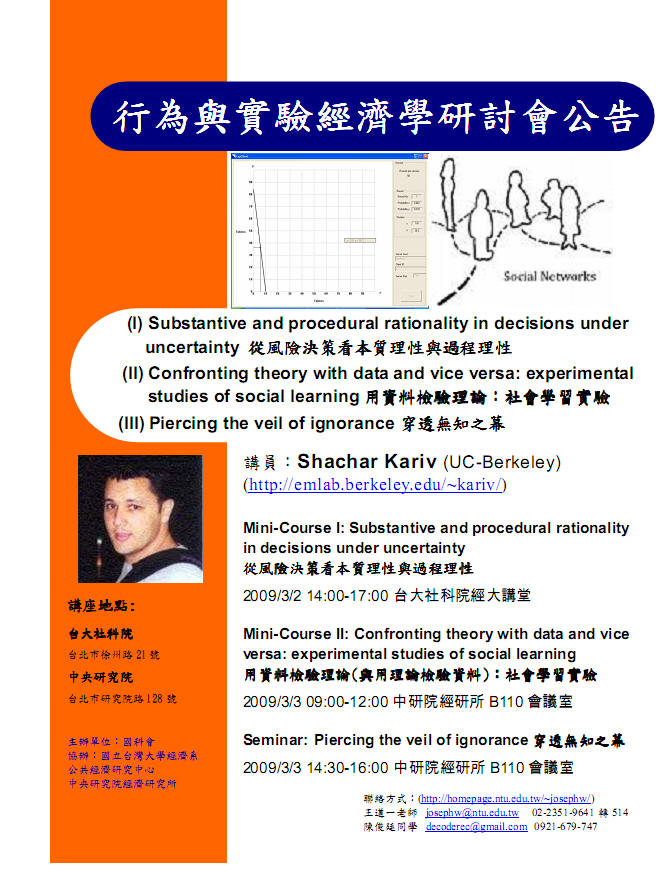
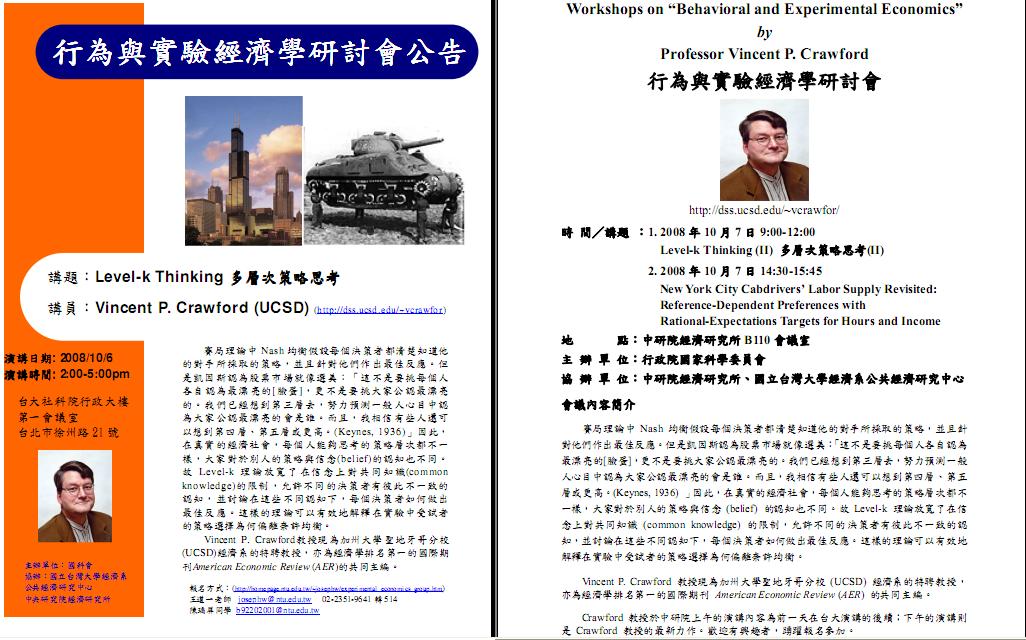
Time: Every other Monday 12:15-1:15pm
(presentation) & 1:15-2:15pm (free discussion)
Place: 台大社會科學院行政大樓第二會議室
(臺北市徐州路21號行政大樓二樓第二會議室)
Contact: Joseph Tao-yi
Wang (josephw "at" ntu.edu.tw)
Cheng-Chen Yang (ccyang "at" econ.sinica.edu.tw)
Chen-Ying Huang (chenying "at" ntu.edu.tw)
Format: One hour
presentation on papers in behavioral and experimental economics, followed by free discussion.
Lunch will be provided to
those who sign up in advance by emailing Joseph Tao-yi Wang.
Topics:
[12/17] Organization Meeting and
Introduction
Paper: Camerer (2003), Behavioral Game Theory, Ch. 1
Presenter: Joseph Tao-yi Wang
[12/31] Dominance-Solvable Games
Paper: Camerer (2003), Behavioral Game Theory,
Ch. 5.
Presenter: Cheng-Chen Yang
[ 1 /14] Mixed Strategy Equilibrium
Paper: Camerer (2003), Behavioral Game Theory,
Ch. 3.
Presenter: Chen-Ying Huang
[ 1 /28] Learning
Paper: Camerer (2003), Behavior Game Theory, Ch.
6.
Presenter: Joseph Tao-yi Wang
[ 2 /18] Guest Lecture (Special Location: 台大社會科學院行政大樓第一會議室
)
Paper:
Wise Crowds or Wise Minorities (with C.
Brunner)
Presenter: Jacob K. Goeree (Div. of Humanities and Social Sciences, Caltech)
[ 2 /25] Guest Lecture
Paper: Visual Pattern Analysis in the Ventral
Stream of the Human Occipital Cortex
Presenter: C. C. Chen (Dep. of Psychology, NTU)
[ 3 /31] Guest Lecture
Paper: How to make machine learn and learn
effectively?
Presenter: Fu Chang (Institute of Information Science, Academia Sinica)
[ 4 / 9 ] Guest Lecture
Paper:
Experiments in Open Contents
Presenter: Benjamin Chiao (School of Information, University of Michigan)
[ 4 /14 ] Special Guest Lecture (Special Place:
社法25)
Paper: Systemic Rationality (12:00-1:45)
Paper:
An exploratory analysis of composite choices: Weighing rationality over
irrationality (2:00-3:30)
Presenter: Bijou
Yang Lester (Drexel University)
[ 5 /19] Social Preferences
Paper: Camerer (2003), Behavioral Game Theory,
Ch. 2.
Presenter: Cheng-Chen Yang
[ 6 / 2 ] Student Presentation
Paper:
A Window of Cognition: Eyetracking the Decision-Making Process in Graphical
Beauty Contest Games
Presenter: Chun-Ting Chen (NTU)
NOTE:
This project is sponsored and supported by the National Science Council and the Public Economics Center of NTU
to promote research in
behavioral and experimental economics.
Last
modified on
十月 06, 2016