PROJECTS
Our research focuses on the epidemiology
of aging and preventive medicine,
with an emphasis on identifying environmental, lifestyle,
functional, and biological determinants of healthy aging. Since
2007, cognitive aging, cognitive impairment, and dementia have been
major research interests of our laboratory. Over the years, our
research has expanded to encompass a broad range of aging-related
health issues, including frailty, sarcopenia, nutrition, oral
health, and other geriatric conditions.
Through observational
epidemiological studies, particularly longitudinal cohort
research, we aim to
understand how multiple risk and protective factors contribute to
changes in cognitive and physical function over time. Our work
integrates epidemiological, clinical, environmental, and biological
data to identify potentially modifiable risk factors and early
markers of age-related conditions, providing scientific evidence to
inform preventive
strategies
and promote healthy aging.
Our research also includes international collaborations across
multiple disciplines. The following sections introduce our major
research projects and related activities.

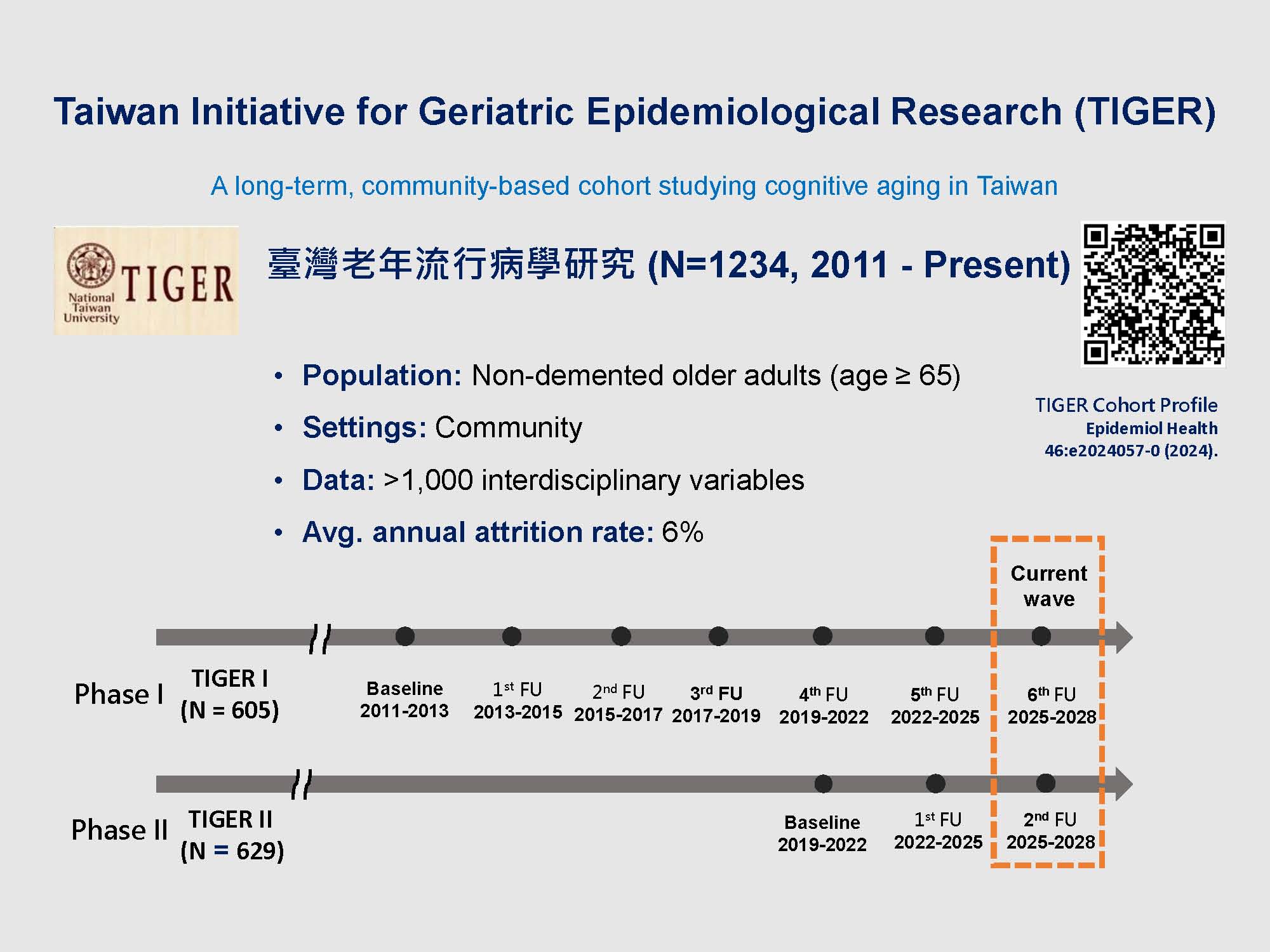
Taiwan Initiative for Geriatric Epidemiological Research (TIGER, 2011-present)
The Taiwan Initiative for Geriatric Epidemiological Research
(TIGER) is a community-based, longitudinal observational cohort
study established in 2011 by Professor Yen-Ching Chen, Dr. Jen-Hau
Chen, and colleagues at National Taiwan University. Rooted in
epidemiology and preventive medicine, TIGER aims to identify
environmental, lifestyle, functional, and biological determinants of
healthy aging, with particular emphasis on cognitive aging, frailty,
sarcopenia, and other aging-related health outcomes,
as well as opportunities for early risk identification and
prevention.
TIGER recruited 605 older adults aged 65 years and above during
Phase
I (TIGER I: 2011–2013)
and an additional 629 participants during Phase II (TIGER II: 2019–2022)
,
resulting in a total cohort of 1,234 participants. Follow-up
assessments are conducted approximately every 2–3 years. The seventh
assessment wave, including baseline as the first wave, began in 2025
and is expected to be completed in 2027. The TIGER cohort is an
ongoing longitudinal study, with continued follow-up and research
planned beyond 2027.
A defining feature of TIGER is its population-level approach to
preventive medicine
and observational design. By following community-dwelling
older adults over time, the cohort seeks to understand how
environmental exposures, lifestyle behaviors, and biological changes
contribute to cognitive and functional aging, including changes that
may precede clinically recognized impairment. Rather than evaluating
specific clinical interventions, TIGER focuses on identifying
potentially modifiable determinants and early markers that may
inform future preventive strategies.
The cohort integrates repeated cognitive and physical function
assessments with extensive data on environmental exposures, dietary
intake and nutritional status, muscle health, frailty, oral health,
sensory function, and aging-related biomarkers. neuroimaging,
retinal imaging, genetic, epigenetic, and metabolomic data further
support investigations into the complex interplay of environmental,
lifestyle, and biological factors in aging.
TIGER brings together researchers from epidemiology, biostatistics,
environmental health, nutrition, geriatrics, neurology,
ophthalmology, and other disciplines. Findings from the cohort have
contributed to research on cognitive decline, dementia, frailty,
dietary patterns, air pollution, retinal markers, and other
determinants of healthy aging.
For further information, please refer to the TIGER Cohort Profile and
our Publications.
▶ Research Themes and Video Guide
◆ Air Pollution and Cognitive Function
Air pollution may affect cognitive decline through vascular and inflammatory mechanisms.
🎥 Theme overview: [00:19:42 – 00:39:45]
◆ Diet and Cognitive Function
Dietary patterns may influence long-term cognitive changes through metabolic and inflammatory pathways, and may involve gut–brain axis mechanisms.
Inflammatory Diet, Gut–Brain Axis, and Cognitive Function
🔗 Read paper | 🎥 Explained at 00:57:31
🔗 Read paper | 🎥 Explained at 00:53:05
🎥 Theme overview: [00:41:10 – 00:57:31]
◆ Multisystem Integrative Framework
Dementia should be viewed as a multisystem and longitudinally evolving process, in which systemic exposures change over time and influence cognitive outcomes through within-person changes.
🎥 Framework overview: [00:04:00 – 00:12:42]
▶ International Collaborations
TIGER has joined and collaborated with international research teams in the following consortium:
1) The Global Alzheimer’s Association Interactive Network (GAAIN) funded by the Alzheimer’s Association, USA, in 2018,
2) The United Consortium in the Netherlands in 2021,
3) Cohort Studies of Memory in an International Consortium (COSMIC), Centre for Healthy Brain Ageing (CHeBA), School of Psychiatry, University of New South Wales, Sydney, Australia in 2022, and
4) Environment Working Group, Enhancing Neuro Imaging Genetics Through Meta Analysis (ENV-ENIGMA), University of South California, Los Angeles, USA, in 2023.

Dementia and Aging Research of Taiwan (DART: 2007-2011)
This is a multi-center case-control study in Taipei, Taiwan. A total of 938 participants aged 60 or older (n=292 AD, n=143 small-vessel vascular dementia (VaD), and n=503 healthy controls) were included from 2007 to 2011. This study has genome-wide (using customized array plates for Chinese population) and candidate-gene data [including apolipoprotein E (APOE) e4 status and 39 single nucleotide polymorphisms (SNPs) of 12 genes], information of demography, comorbidities, and leisure activities.
GAAIN (Global Alzheimer’s Association Interactive Network) is funded by the Alzheimer’s Association, USA. It has developed the first operational online integrated research platform, which links scientists, shared data, and sophisticated analysis tools. Our Dementia and Aging Research of Taiwan (DART) joined GAAIN in September 2016. We look forward to future collaborations through data sharing via GAAIN.
Osteoporosis Project
About 10 million and 34 million of Americans have osteoporosis and low bone mass, respectively. Among them, 80% are women who are at high risk of fracture. Osteoporosis is a common health issue among postmenopausal women and over 50% of this population has increased risk of fracture. WHO reported that osteoporosis has been an important health issue secondary to coronary heart disease. Although osteoporosis is preventable and curable, no clear symptoms could be identified before the occurrence of fracture, which is associated with higher mortality. Family studies found that 30% to 80% of variations of bone mineral density were attributable to genetic factors. However, previous candidate-gene association studies observed inconsistent findings. Therefore, the etiology of osteoporosis remains unclear. Recently, GWASs found that some single nucleotide polymorphisms (SNPs) were associated with bone mineral density and osteoporosis. In addition to genetic markers, our lab also look into metabolome, various clinical factors and lifestyle in relation to the risk of low bone mineral density.
