



Estuaries are coastal embayments where river and ocean meet and mix. They are very productive but vulnerable to pollutions. Estuaries receive complex forcing from river, tides, density contrast (i.e. difference between fresh river water and salty ocean water), wind, etc, making them natural laboratories for studying fluid physics. I have been studying estuarine dynamics since my dissertation work. Some research subjects are:


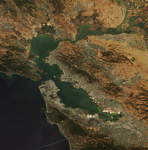
Chesapeake Bay, USA
San Francisco Bay, USA
Danshui River, Taiwan
(images from Earth Snapshot)

Exchange between estuarine and ocean water in long (with respect to tidal excursion) estuaries is relatively well understood: density difference between river and ocean drives a two-layer exchange flow, named gravitational circulation. But, in short estuaries, a density contrast does not exist during much of the ebb tides, suggesting that the exchange must be accomplished by other mechanisms (like tidally-driven exchange). In this study, we use a new isohaline method to quantify the exchange flow in long and short systems and to identify their driving mechanisms (see Chen et al. 2012 on JPO)
Estuarine Exchange Flow
Collaborators: Rocky Geyer, Dave Ralston (WHOI), Jime Lerczak (OSU)
Blowing axial wind over a partially mixed estuary may not always lead to decreases of stratification. Under appropriate conditions, down-estuary wind can actually enhance stratification by creating a vertically sheared flow that strains the salinity field (i.e. wind straining). We investigated this interesting phenomenon and proposed a regime diagram to classify wind’s roles based on the Wedderburn number and entrainment depth ratio (see Chen and Sanford, 2009 on JPO)
Wind Controls of Stratification
Collaborators: Larry Sanford (UMCES)


down-estuary wind

N increase
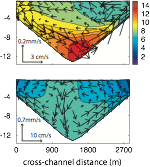
Secondary circulation (i.e. in cross-channel direction) has recently received lots of attention because of its roles in re-distributing momentum and scalars. The driving mechanisms for secondary circulation include differential advection, Coriolis deflection, curvature, wind-driven Ekman transport, and boundary mixing. We study a variety of these mechanisms, aiming at identifying their controlling parameters (see Chen et al. 2009 on JGR; Chen et al. 2009 on CSR)
Secondary Circulation
Collaborators: Jim Lerczak (OSU), Rocky Geyer (WHOI), Larry Sanford (UMCES)


Estuarine Adjustment
Understanding over what time scales an estuary adjusts to forcing variations is central to estuarine dynamics. If the adjustment time is much longer than the forcing period, an estuary is inherently unsteady as it cannot keep pace with the forcing changes. Therefore, classic steady-state theories would give a poor estimate of subtidal flow structure. Linear theories of estuarine adjustment time exist. However, they are handicapped by a heavy assumption that forcing perturbation is small such that the forced, nonlinear system can be linearized. Chen (2015) relaxes this assumption to explain why, for a symmetric, step change in river forcing, the estuarine respond is asymmetric. A new nonlinear theory for the response time scale is proposed.
