Organic Photodetectors
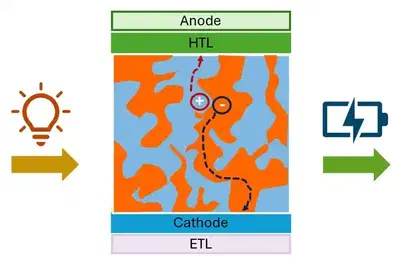
Organic photodetectors (OPDs) convert light signals carrying information into an electrical current. Light is typically absorbed in a photoactive layer based on a blend (i.e., bulk heterojunction) of two materials, an electron donor and an electron acceptor. In typical devices, the energy offset between two organic materials blended together provides the driving force to dissociate electrons and holes created under light (see the schematic above). To quantify the performance of OPDs, several figures of merit are utilized, such as:
- External quantum efficiency (or responsivity): the ratio between how many electrons can be extracted from the device in response to photons hitting it
- Dark current: parasitic electric current generated without a light signal, determining the device noise
- Detectivity: combining the information of both quantum efficiency and dark current in a single figure of merit
- Linear dynamic range: how many orders of magnitude of varying light intensity can generate an electrical signal linearly proportional to the light signal
- Photodetector speed: how fast electrical signal can be extracted after light hits the device
- Wavelength selectivity vs broadband: depending on OPD application, only photons of specific wavelengths or a wide spectral coverage can be targeted
In our lab, several aspects of OPDs are explored towards deeper understanding of their working mechanisms and improvement of performance and stability, for example:
- How can we fabricate OPDs capable of harvesting infrared light? Can we push the photodetection to wavelengths beyond 1500-2000 nm?
- How can we optimize molecular design of photoactive materials and architecture of device stack for maximum performance?
- What is the origin of performance losses in OPDs? Especially, what loss mechanisms are involved when we target infrared photodetection?
- How does OPD performance evolve when we operate in real-world conditions for long periods? Are OPDs stable?
- What disruptive technologies can be demonstrated when we integrate infrared OPDs into more complex electronic circuits?