13. The Case of the Missing
Fundamental
We have learned that when we hear a periodic
sound, the pitch we perceive is based on the fundamental
frequency of the sound, rather than on any of the
harmonics (also called "overtones" or "partials") which may also
be present in the signal. We also know that the fundamental
frequency is the lowest in frequency of the harmonics
(there are exceptions to this which we will disregard for now)
and it also has the greatest amplitude of all the
harmonics. But the reason we perceive only the pitch of the
fundamental frequency is not due simply to its greater
amplitude.
We know that the harmonics of a
sound occur at progressive multiples of the fundamental
frequency, e.g. 100, 100 x 2 = 200, 100 x 3 = 300, 100 x 4 =
400, and so on. But what would happen if we were to remove only
the fundamental frequency from a sound and keep all of the other
harmonics? What would you "hear" as the "pitch" of such a sound?
You may find the answer a bit surprising.
On this page, you can first hear a tune played with a simple
sine wave, then the same tune played with the first nine
harmonics. In the third sound file, the first three
harmonics have been removed:
http://auditoryneuroscience.com/?q=topics/missing-fundamental
The timbre is somewhat different, but you hear basically
the same tune at the same pitch.
So the
pitch your ear and brain "hear" is in each case not based on
the harmonic with the lowest frequency; you "hear" rather the
tone as having the pitch of the original fundamental
frequency, even when it is not physically present in the
signal! Why does this happen?
Well, very simply, it would seem that
it is the harmonic structure that determines our perception of
pitch, rather than simply the frequency of the lowest harmonic
that is physically present in the signal. It is as though our
brains calculate the difference in Hertz from one harmonic to
the next to decide what the real "pitch" of the tone is. This
is called a "difference tone".
You can hear and see this phenomenon
explained and demonstrated here:
https://www.youtube.com/watch?v=i_0DXxNeaQ0&feature=youtu.be&t=665
Another demonstration:
https://www.youtube.com/watch?v=0amvhGzeCnQ
Here is Wikipedia's entry on the Missing Fundamental, with a
sound file:
http://en.wikipedia.org/wiki/Missing_fundamental
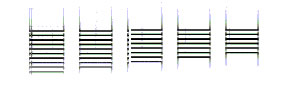
To help you visualize what's going on,
the figure below shows a spectrogram of the same pitch with the
lowest frequency successfully removed. If you like, you can try
making a spectrogram of the sound yourself with Praat to confirm
the harmonic structure of the tones.
Additionally, when you hear two pure
tones, even when they do not have the same harmonic
structure, the ear and brain again subtract one frequency from
the other, and you "hear" a lower-pitched tone with a frequency
equivalent to this difference.
For example, if you've ever played with
a two-tone whistle (e.g. a (London bobby whistle another example), you
may remember that when blowing it, you heard a third, lower tone
in addition to the whistle's two original tones. This is called a Tartini
tone or combination tone.
If the difference between the two
pitches is about 70 Hz or less, you usually hear a pitch that is
an average of the frequencies of the two tones, with a "beat".
The rate of the beat will be determined by how big the
difference in frequencies is.
When the difference is greater than 70
Hz, however, you will hear a lower third pitch equivalent to
the difference between the two frequencies.
More information on missing
fundamentals and difference frequencies with a two-tone
whistle:
ß
http://hyperphysics.phy-astr.gsu.edu/hbase/sound/london.html#c1
Actually, the same thing happens with
"sum tones", i.e. if you play two simple tones, you will also
hear a tone with a frequency of the sum of the two tones, e.g.
you will hear a faint tone at 900 Hz if you simultaneously play
two pitches at 400 Hz and 500 Hz.
See this video for more details: How To Play Notes That Aren't There
Amazing?
The difference tone phenomenon is
exploited in designing telephone systems and small stereo
speakers. How? Go on to the next page and find out!
Next: Forry, wrong number! I: The frequency
ranges of speech and hearing
on to next page
back
index I
index
II home